
The honest answer to “what does a heated driveway cost to run” is that it depends on four things, and only one of them is the price of fuel. The other three are how many BTUs the system has to put into the surface to clear it, how hot the fluid has to be to get them there, and how many hours a year the system runs. ThermaPANEL changes all three, and that is where the running cost comes from.
Where the energy goes
A snowmelt system does three jobs in a storm: it warms the surface from whatever temperature it sat at up to 33 F, it melts the snow landing on it, and it replaces the heat the wind and the cold air pull out of a wet surface. Only the second one is fixed by the weather. The first depends on how much mass sits between the heat and the snow. The third depends on how long the surface stays wet after the snow stops.
Tubing in a concrete slab has to warm at least four inches of concrete before the top of the slab moves at all. That takes hours and it takes high supply temperatures, and most of that heat goes into the ground under the slab and out the edges. ThermaPANEL sits directly under the paver, with fluid across the whole panel and insulation under it, so the heat goes into the paver and nowhere else. There is no mass to preheat, so the system can start when the snow starts instead of hours before, and it can stop when the surface is dry instead of running on while a slab cools.
What temperature the fluid has to be
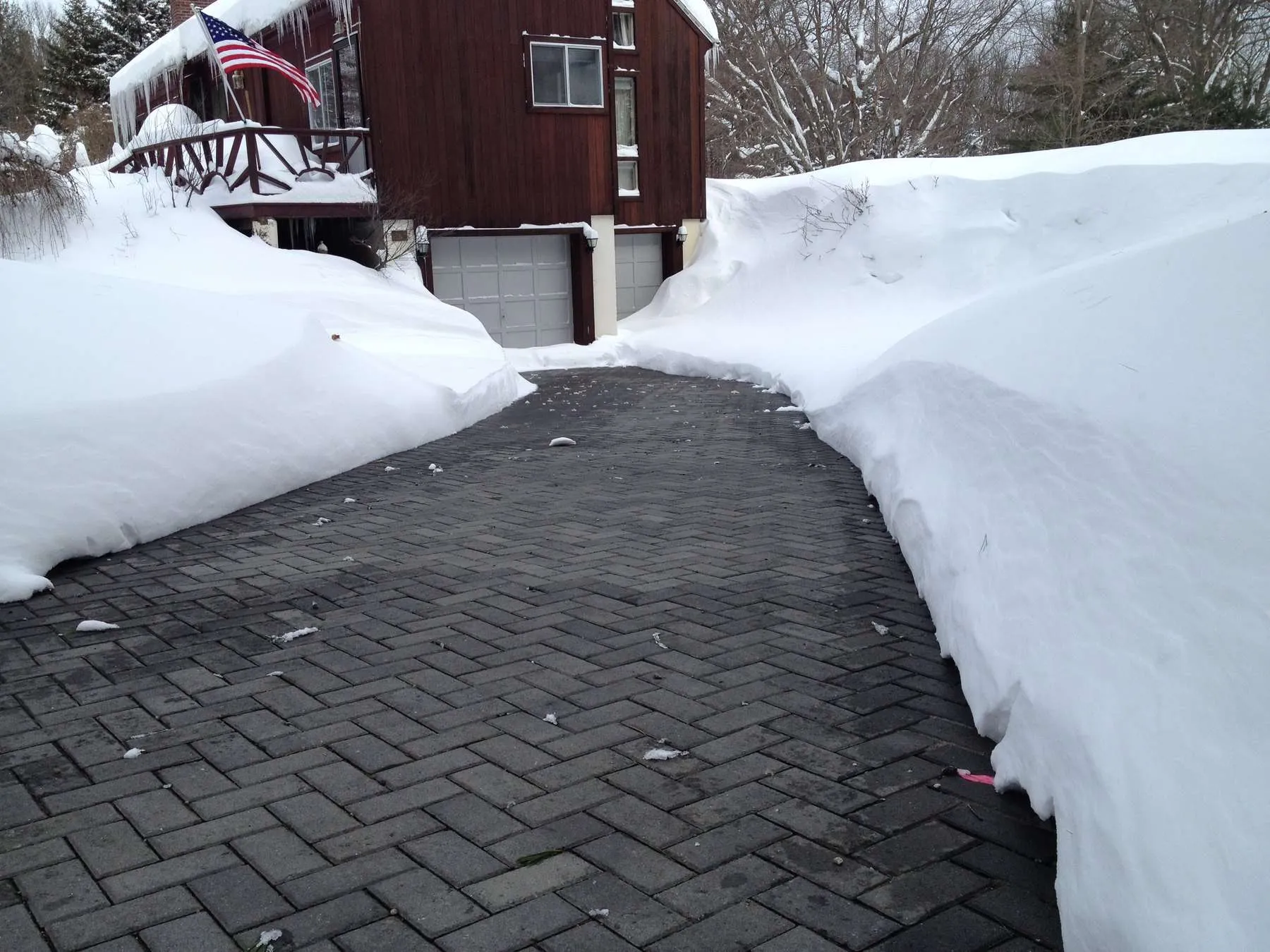
This is the number that decides the fuel bill. A boiler running 140 F glycol to push heat through a slab is a boiler running at its least efficient. A heat pump cannot make 140 F at all in cold weather. Our snowmelt designs supply 100 to 130 F, and the first ThermaPANEL installation ever, a herringbone paver driveway in New England, ran on a zone valve off the house boiler at a supply under 60 F. The homeowner’s heating boiler runs the driveway as one more zone, at a temperature where a condensing boiler condenses and an air to water heat pump is in its comfortable range. High output at low temperatures means high COP for heat pumps.
How many hours a year
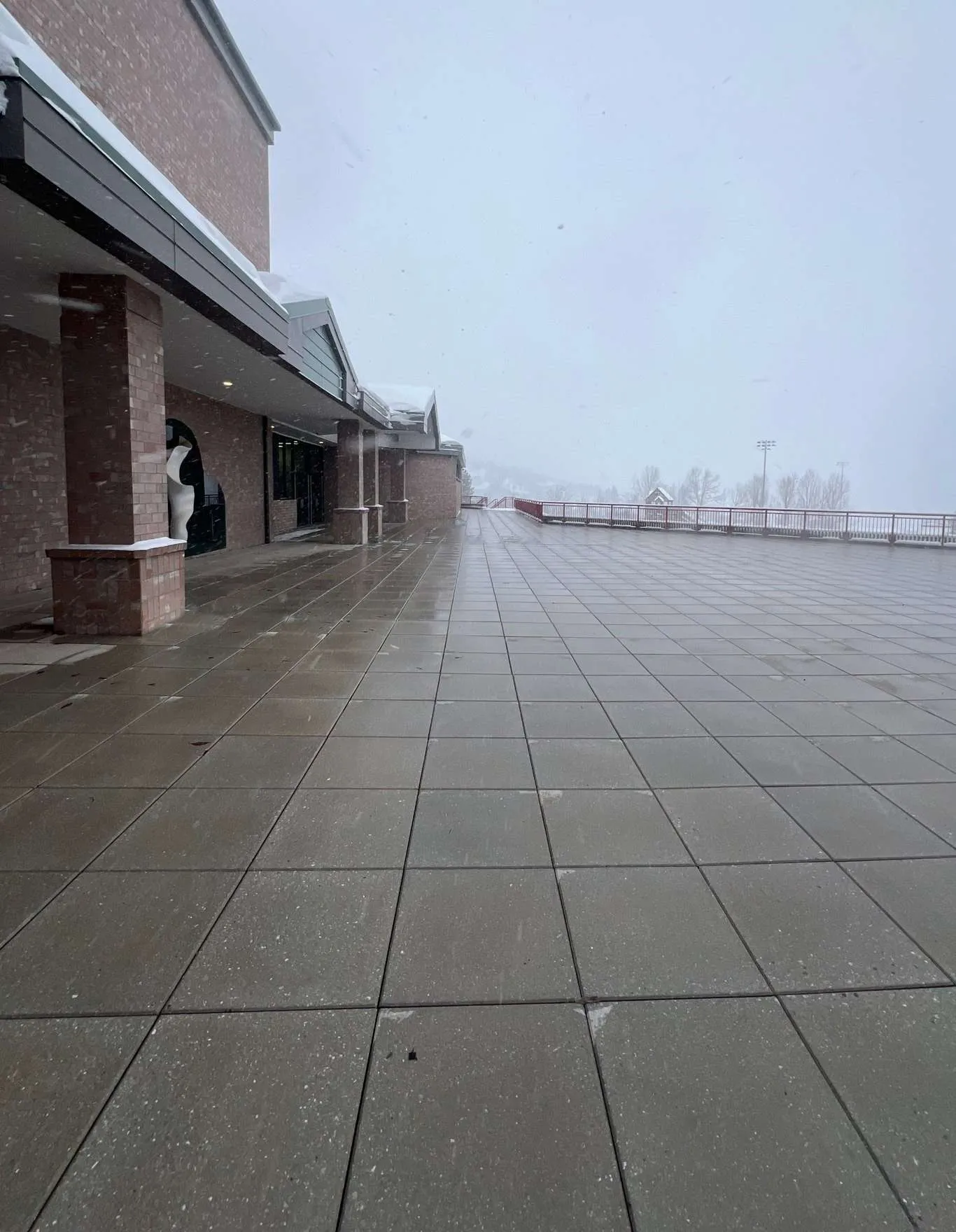
A surface sensing control, which the energy codes now require, starts the system when the sensor sees moisture and freezing temperature at the same time and stops it when the surface is dry. On a low mass system that means the run time tracks the storms. On a slab, the owner often leaves it idling because the restart takes too long, and idling is where the big bills come from. Aspen’s 200 million BTU annual cap and Breckenridge’s fee per heated square foot both exist because of slabs left idling through the winter. A system that only runs when it is snowing is the one that fits under those rules; the details are on our snowmelt energy codes page.
Putting a number on it
We do not publish a cents per square foot figure, because the design snowfall in Portsmouth is not the design snowfall in Steamboat and the price of a therm is not the price of a kilowatt hour. What we do for every project is run the annual energy estimate from the local design weather data, the heated area, the surface and the heat source, and hand it to you with the layout. In Aspen and Pitkin County that estimate goes on the permit application. Everywhere else it is the number you use to compare against the plow contract and the salt.
What we can say in general: on the same surface, in the same storm, a low mass panel system at 100 to 130 F uses less fuel than tubing in a slab at 140 F, because it is not heating concrete and ground, and it runs fewer hours because it responds in minutes and shuts off when the surface is dry. The panel vs tubing comparison goes into the physics.
What else is in the running cost
- Circulator power. ECM circulators, a few tens of watts while running.
- Glycol. Inhibited propylene glycol, checked at the start of each season, topped up by an automatic feeder. Years between changes.
- Repair. On a paver system, lift the paver, swap the panel. On a slab, there is no repair, there is replacement. Over the life of a driveway that is the largest number of all, and it is zero until it is not.
- Lost revenue, on a commercial surface. A restaurant terrace or an observation deck that closes for snow loses the day. One famous New York observation deck still shovels by hand into a propane snow melter on the roof because it could not afford to close long enough to retrofit.
- What the alternative really costs. Snow does not disappear when it is plowed; it is moved, and moving it is energy too. Some mountain resort towns truck the snow off their streets to gas fired snowmelt machines outside town. A heated surface melts it where it falls, once, with no truck, no diesel and no second melt.
- What you stop paying for. The plow contract and the salt. The space a plow needs to pile the snow, which on a tight lot or a roof deck does not exist. The chipped pavers and crushed plantings a plow blade leaves behind, and what salt does to both. The shoveling, and the day the car could not get out.
- Falls. Ice on a walk or a deck is a liability before it is anything else. For a hotel, a hospital or a condominium the first slip and fall claim costs more than the system; for a homeowner it is a hip. A surface that is dry is the only one that is safe.
Send us the plan
Site plan with the heated area marked, square footage, the paver and the heat source you have in mind. We return a layout and the annual energy estimate for your location. Contact Therma-HEXX engineering or call (603) 319-8815.